
Catenaccio, Total Football and Football's Tactical Revolutions
Contents The Tactical Revolution After the WM What Was Catenaccio? Helenio Herrera and Inter Milan The Libero: Defender or Playmaker?
Catenaccio Was More Than Defence The Rise of Total Football Rinus Michels: The Architect of Total Football Johan Cruyff: The Player Who Made It Possible What Made Total Football Different? Ajax and the European Cup Revolution The Netherlands at the 1974 World Cup Catenaccio vs Total Football When Systems Collide From Libero to Ball-Playing Defender From Total Football to Positional Play The Tactical Revolution in Numbers The Tactical Ideas That Survived Why Catenaccio and Total Football Still Matter Football's tactical evolution has never been a straight line.
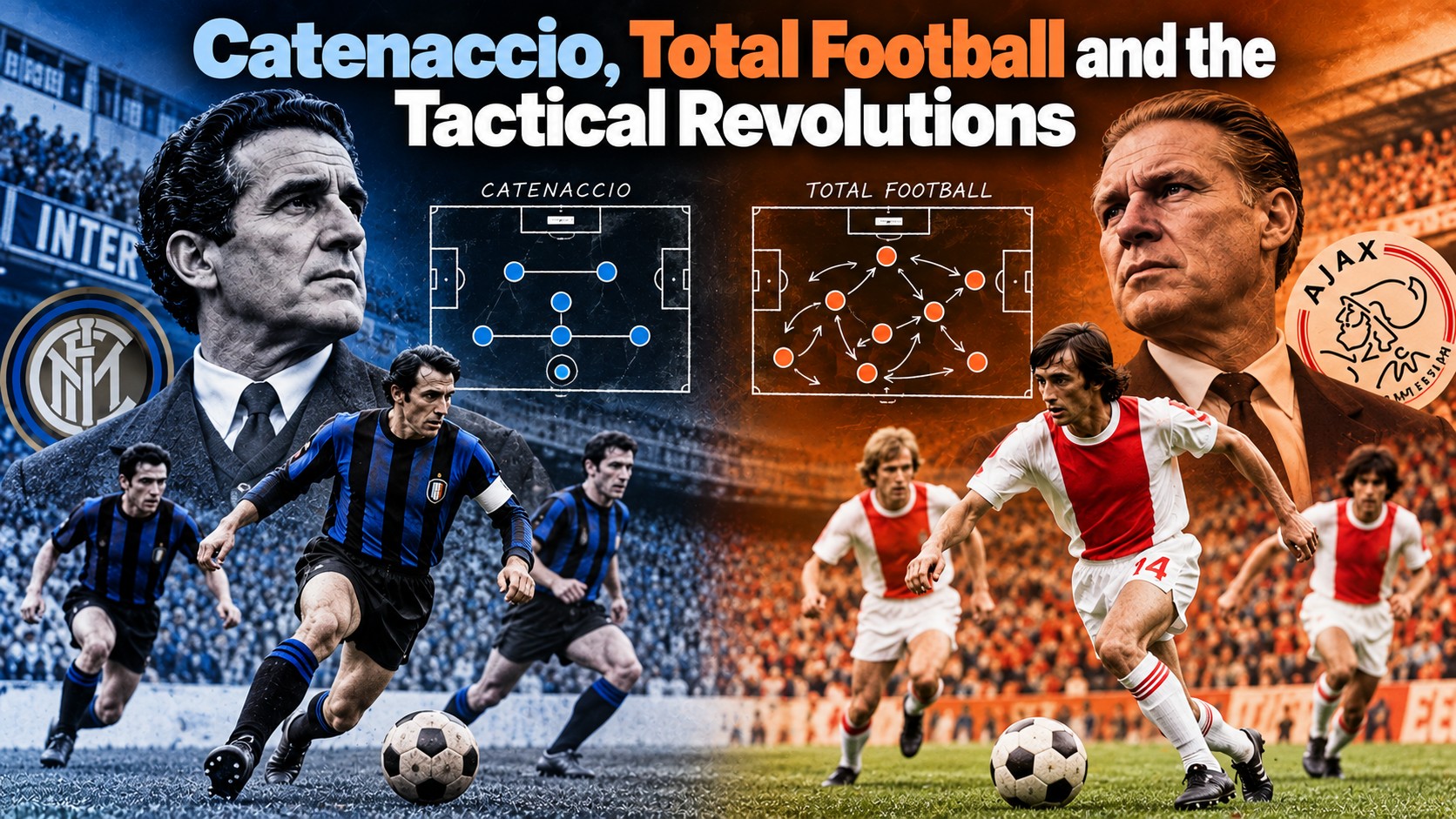
Every new system creates a problem for the opposition, and every problem invites another tactical response. In the 1960s and 1970s, that process produced two of the most influential football philosophies in history: Catenaccio and Total Football.
At first glance, they appeared to represent completely different ideas. Catenaccio became associated with defensive organisation, man-marking, a sweeper and rapid counter-attacks.
Total Football emphasised movement, positional interchange, pressing and the ability of players to operate in different areas of the pitch. Yet both systems were built around the same fundamental idea:control space.
The story of Catenaccio and Total Football is therefore not simply a battle between defence and attack. It is the story of football becoming increasingly sophisticated, as managers searched for new ways to control the pitch and exploit the weaknesses of their opponents.
The Tactical Revolution After the WM By the middle of the 20th century, the WM formation had already transformed football. The old 2-3-5 Pyramid had evolved into a more structured system in which defensive organisation and positional discipline were increasingly important.
But the WM was not the end of tactical evolution. Across Europe and South America, coaches were experimenting with different ways of defending, attacking and controlling space.
Some teams concentrated on defensive security before launching fast counter-attacks. Others looked for greater freedom of movement and collective attacking combinations.
Written by
Sebastian Hox