
The Managers Who Changed Football: Tactical Revolutionaries
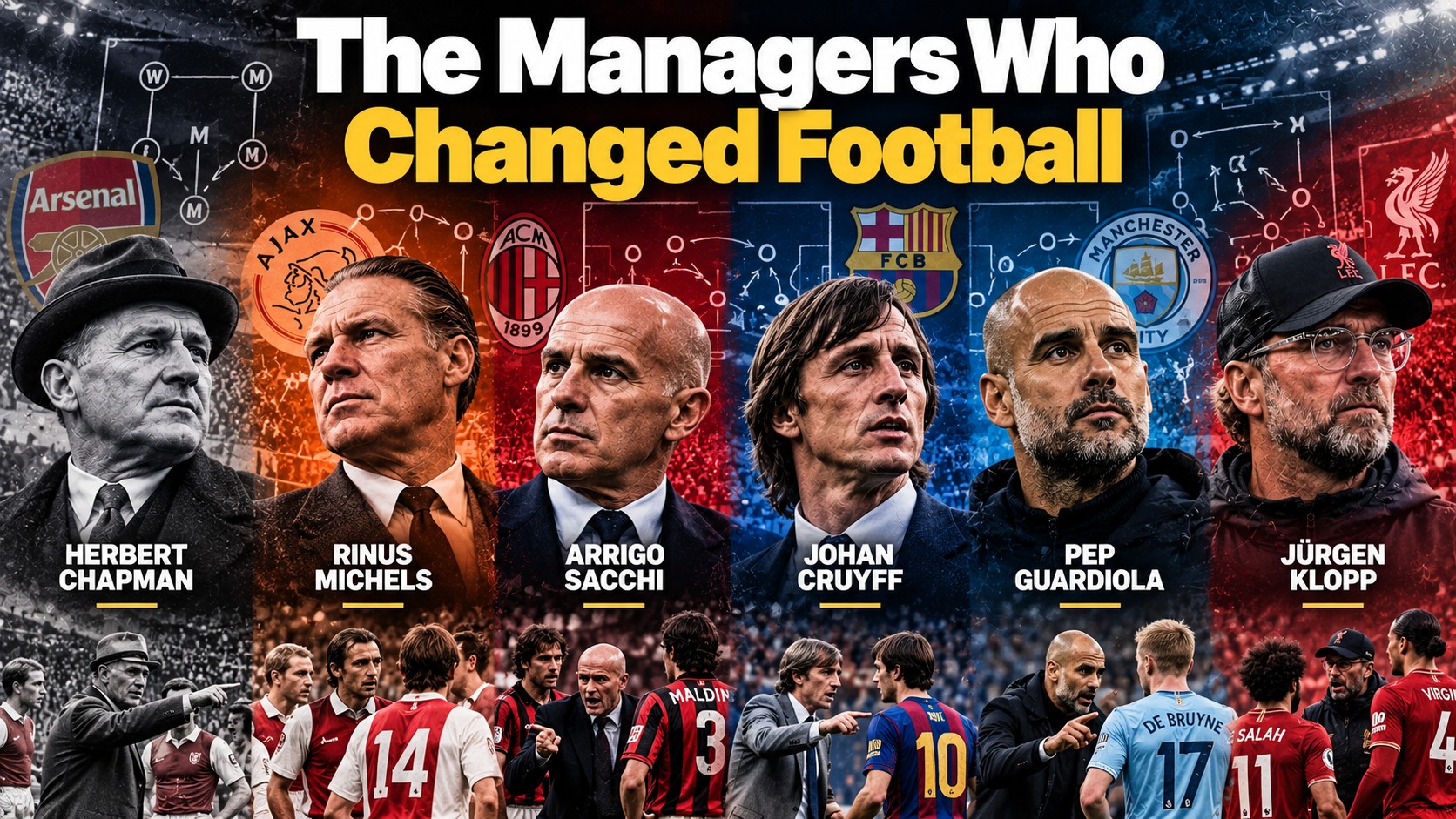
Contents Herbert Chapman: Football Finds Its Shape Rinus Michels: Football Becomes Fluid Arrigo Sacchi: The Defence That Attacked Johan Cruyff: The Manager Who Changed Barcelona From Cruyff to Guardiola Pep Guardiola: Football as Positional Play The Barcelona Six-Trophy Year Jürgen Klopp: The Counter-Pressing Revolution Different Managers, Similar Questions The Managers Who Changed Football Football Managers FAQs The Evolution of Football Football tactics do not evolve by themselves. Behind every major tactical revolution are managers willing to question established ideas, experiment with new systems and persuade players to see the game differently.
From the WM formation of Herbert Chapman to the Total Football of Rinus Michels, the pressing revolution of Arrigo Sacchi and the positional play of Johan Cruyff and Pep Guardiola, certain managers have changed not only how their teams played, but how football itself was understood. Some changed the way players occupied space, while others transformed the relationship between possession, pressing and defending.
This is the story of the managers whose ideas helped drivethe evolution of football. Herbert Chapman: Football Finds Its Shape Few managers were more influential in the transformation of early English football than Herbert Chapman.
Chapman's importance was closely connected to the major offside law change of 1925. With attackers suddenly able to exploit more space behind defensive lines, the traditional 2-3-5 Pyramid needed to evolve.
At Arsenal, Chapman helped develop the tactical structure that became known as the WM formation. The centre-half dropped deeper to create a third defender, while the overall team became more balanced between defence and attack.
Chapman's Arsenal went on to win the FA Cup in 1930 and the First Division title in 1930-31, demonstrating how tactical innovation could translate into sustained success. But Chapman's influence extended beyond formations.
He introduced ideas around training, preparation, player recruitment and tactical organisation that helped move football management towards a more modern profession. Rinus Michels: Football Becomes Fluid If Chapman helped give football a new defensive structure, Dutch manager Rinus Michels helped make the game far more fluid.
Michels developed his ideas at Ajax during the 1960s and became the central managerial figure associated with Total Football. His teams were built around movement, positional interchange, pressing and technical ability.
Players were expected to understand not only their own position but the spaces occupied by their teammates. Ajax won the European Cup three times in succession from1971 to 1973, while Michels later took his ideas to the Netherlands national team.
Written by
Sebastian Hox